
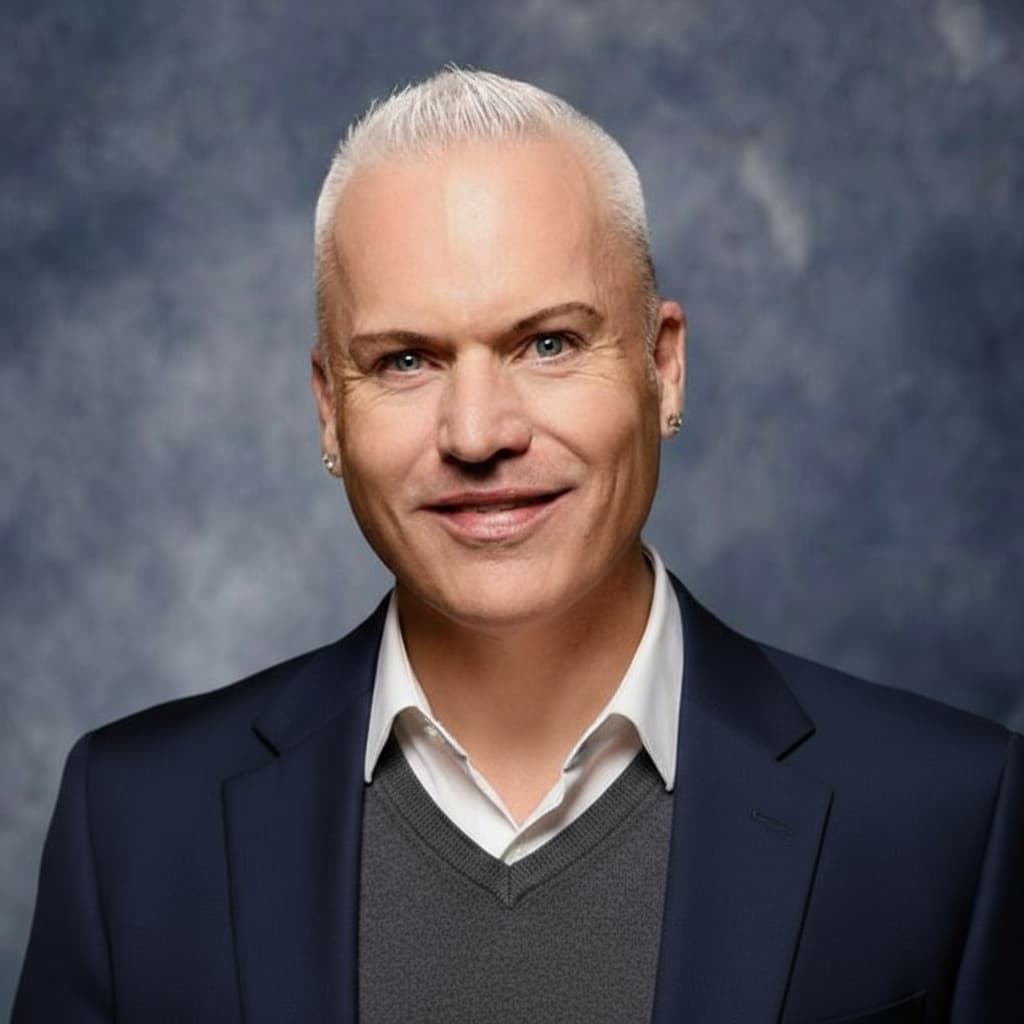
In an era where artificial intelligence dominates headlines and technological disruption reshapes industries daily, Christopher McCormick stands as a powerful reminder that the human element remains the ultimate catalyst for organizational success. As CEO and CHRO of Visionary Consulting, he has built his reputation on a simple yet profound belief: businesses don’t happen without people.
This philosophy has guided McCormick through transformative roles at industry giants like Gilead Sciences and Blue Shield, where he didn’t just manage human resources but reimagined what it means to put humans at the center of business strategy. His journey from traditional HR leadership to founding his own consultancy represents more than career evolution; it embodies a fundamental shift in how organizations approach their most valuable asset.
“It’s about creating space for growth, development and flourishing,” McCormick explains when defining his leadership philosophy. “I want to empower people and organizations to navigate the future with purpose, grace and ease.” This vision extends far beyond conventional HR practices, encompassing a holistic approach to organizational transformation that treats culture as the ultimate competitive advantage.
THE AWAKENING: CULTURE AS THE MAGIC ELIXIR
McCormick’s understanding of organizational dynamics crystallized through years of witnessing companies struggle with the disconnect between strategy and execution. His breakthrough came with recognizing that sustainable success requires more than operational excellence or technological innovation.
“In today’s dynamic business landscape, organizations are finally waking up to the realization: a vibrant culture infused with inclusivity, diversity, creativity, and relentless learning is the magic elixir that ignites innovation and propels success to new heights,” he observes.
This realization shaped his approach to workforce transformation, where success isn’t measured merely in productivity metrics or cost reductions but in the creation of environments where diverse talents can flourish. McCormick likens this to “a potluck where every dish is a winner, and no one brings the potato salad with raisins,” emphasizing how embracing different backgrounds creates a melting pot of ideas that leads to groundbreaking solutions.
His work consistently demonstrates that when voices from different backgrounds come together, organizations don’t just improve their problem-solving capabilities; they enhance decision-making at every level and foster the kind of creativity that drives true innovation.
STRATEGIC ARCHITECTURE: BUILDING PEOPLE-FIRST ORGANIZATIONS
McCormick’s consulting approach centers on creating People & Culture Plans that align with business strategies for the next 2-3 years. This methodology helps organizations articulate a people roadmap that can support and enable business priorities, ensuring human capital strategy isn’t an afterthought but a fundamental driver of success.
“I’m always coming to the table with the lens of people/humans first,” McCormick emphasizes. “Businesses don’t happen without people. If it is the last thing the leadership team or C-Suite thinks about, or it’s an afterthought, they’ve missed the mark.”
His observations about the evolving corporate governance landscape reveal significant shifts in how organizations approach talent strategy. Recent data showing a 147% increase in HR/Talent committees being added to Boards of Directors validates his long-held belief that people strategy must be integrated into business strategy at the highest levels.
This evolution from traditional compensation committees focused primarily on financial impacts to comprehensive talent strategy committees represents a fundamental recognition of human capital as the ultimate driver of organizational success.
THE BALANCING ACT: ALIGNMENT WITHOUT COMPROMISE
One of McCormick’s most valuable insights concerns the delicate balance between strategic alignment and cultural authenticity in large, diverse organizations. His approach challenges the conventional wisdom that alignment requires compromise of authentic culture.
“It’s all about prioritizing,” McCormick explains. “Yes, AND… I will and do often insert that is just as important to ‘de-prioritize’ what is going to get in the way.” This dual focus on prioritization and de-prioritization prevents the dilution that occurs when organizations try to be everything to everyone.
The magic, according to McCormick, happens when organizations get very clear on what is most important and find ways to connect it to people and the behaviors required to meet those priorities. This approach maintains cultural authenticity while ensuring strategic alignment, creating the kind of organizational coherence that drives sustainable success.
REVOLUTIONIZING DEI: FROM REACTIVE TO TRANSFORMATIVE
McCormick’s approach to Diversity, Equity, and Inclusion represents a fundamental departure from the reactive strategies that have characterized much of the corporate DEI landscape. Drawing on the SCARF model from the Neuroleadership Institute, he provides people leaders with practical frameworks for creating inclusive environments.
The SCARF model, focusing on Safety, Certainty, Autonomy, Relatedness, and Fairness, offers leaders actionable guidance for putting employees in forward states rather than stress states. “Employees need all of those things,” McCormick explains. “They need safety, they need certainty.”
His analysis of current DEI challenges reveals deep systemic issues that go beyond surface-level representation. McCormick identifies how quick-fix approaches to diversity often reinforce the very structures they claim to address, creating cycles of recruitment and loss that prevent meaningful progress.
“These reactionary approaches and rulings negate the systemic design and on-going experiences marginalized communities continue to have,” he notes, pointing to the need for sustained, courageous effort rather than temporary initiatives driven by external events.
His vision for transforming DEI efforts emphasizes playing the long game, requiring “courage and grit in the face of challenges” to create true equity and maintain employee engagement. This approach transforms DEI from a compliance initiative into a fundamental driver of organizational effectiveness.
PERFORMANCE REVOLUTION: BEYOND THE NINE-BOX
Perhaps no area better illustrates McCormick’s innovative thinking than his ongoing effort to revolutionize performance management systems. His mission to eliminate or fundamentally transform the traditional nine-box approach reflects his commitment to development-oriented leadership.
“It may be my life’s work to figure out how to break or eliminate the 9-box,” McCormick admits. “I’ve been working on it for years.” His pilot programs across different companies have successfully reduced complexity from nine boxes to seven, then to four, with the ultimate goal of elimination.
His reasoning is both practical and philosophical: traditional rating systems short-cut the real thinking leaders need to bring to develop their teams for the long term. McCormick believes that if people leaders were having meaningful development and performance conversations and taking actions consistent with them, traditional performance management structures would become unnecessary.
This vision represents a fundamental shift from evaluation-focused to development-focused performance management, where the goal isn’t to categorize employees but to accelerate their growth in alignment with organizational needs.
MASTERING CHANGE: THE POWER OF PURPOSE-DRIVEN COMMUNICATION
McCormick’s expertise in change management centers on a deceptively simple principle: getting really clear on outcomes and communicating relentlessly. However, his approach goes deeper than traditional change management methodologies by focusing on the behavioral changes that drive lasting transformation.
“Part of why change efforts fail is that companies can lose sight of the why and the impact,” he observes. “The change cannot be about the what, or the tasks. You have to tie it to the behavior change you want to see long term and bring people along.”
His work with a healthcare client perfectly illustrates this principle. When traditional training and process improvements failed to increase emergency contact collection, McCormick helped them shift focus to the human impact. By telling two stories about how contact information had saved one patient’s life while its absence contributed to another’s death, they achieved a 52% improvement in one month.
This example demonstrates McCormick’s core insight: sustainable change requires emotional connection to purpose, not just procedural modification.
CULTURE CREATION: CONNECTING TO THE BIGGER WHY
McCormick’s philosophy on creating workplace cultures that employees genuinely love centers on connecting daily work to larger purposes. His experience at Gilead and Blue Shield, where the mission of improving patient outcomes and creating health equity provided clear purpose, illustrates how powerful this connection can be.
“When I was working at Gilead and Blue Shield, it was always so easy to connect to improving patient outcomes and creating health equity,” McCormick reflects. The key lies in embedding this purpose as “the red thread that is communicated in every project, effort or change.”
This approach creates the kind of organizational coherence where people want to work for missions bigger than themselves, transforming work from transaction to transformation.
PROCESS INNOVATION: THE HUMAN ELEMENT IN EFFICIENCY
McCormick’s application of Six Sigma methodologies to HR processes yielded impressive results, reducing development timelines by 28% while maintaining quality. However, his key insight goes beyond efficiency gains to the importance of maintaining human-centered focus within process optimization.
“What I really learned in the process was to not lose sight of the people and employee voice and sentiment,” McCormick explains. This led him to embrace design thinking principles and human-centered design more deliberately, achieving better results by “talking to the people doing the work, and not just the exec teams 3 layers removed.”
His observation that leaders often spend too much time “managing optics and egos than actually getting to the solutions that are going to make the biggest impact” reveals a common organizational dysfunction that process innovation can address when properly implemented.
THE INTEGRATED LEADER: PERSONAL AND PROFESSIONAL UNITY
McCormick’s approach to leadership reflects a holistic understanding of personal and professional integration. When asked about his proudest accomplishment, he rejects the artificial separation between personal and professional achievement.
“I don’t see them as separate: personal or professional,” he explains. “As a whole person, what I stand for in my personal life is going to show up in how I contribute to the work I do and results I bring.” His greatest pride comes from maintaining a learning mindset, continuously seeking feedback and remaining open to growth and transformation.
This integration creates the kind of authentic leadership that resonates with modern employees who expect leaders to be genuine, vulnerable, and committed to mutual growth.
FUTURE VISION: THE END OF COMMAND AND CONTROL
McCormick’s vision for the future of organizational leadership represents a fundamental paradigm shift away from traditional hierarchical models. “Command and control leadership is a thing of the past,” he declares. “Leaders today and in the future must have Meaningful Conversations with employees.”
His framework for future leadership emphasizes authenticity, transparency, and connection, where leaders demonstrate care while acknowledging their own imperfections and need for support. This creates what McCormick calls “200% accountability: 100% on the Leader and 100% on the employee.”
This vision transforms leadership from a position of authority to one of mutual accountability and shared growth, creating organizations where both leaders and employees support each other’s development journeys.
THE CONSULTING CATALYST: SCALING TRANSFORMATION
Through Visionary Consulting, McCormick is scaling his approach to organizational transformation beyond individual companies to create systemic change across industries. His focus on People & Culture Plans that align with business strategy ensures that human capital considerations are integrated into strategic planning from the beginning rather than added as an afterthought.
His work reflects a broader recognition that in an age of rapid technological change, the organizations that thrive will be those that can harness human potential most effectively. This requires leaders who understand that culture isn’t just about employee satisfaction but about creating the conditions for innovation, creativity, and sustained performance.
LEGACY OF TRANSFORMATION
Christopher McCormick represents a new generation of organizational leaders who understand that sustainable success requires treating people as the center of business strategy rather than simply a resource to be managed. His career demonstrates that when organizations truly embrace human-centered approaches, they don’t just improve employee engagement; they enhance innovation, decision-making, and long-term performance.
As businesses continue navigating an increasingly complex landscape of technological disruption, regulatory change, and social evolution, leaders like McCormick provide essential guidance on maintaining human connections while driving transformation. His example shows that the most effective organizational changes are those that honor human needs while achieving business objectives.
The future belongs to organizations that can combine strategic clarity with cultural authenticity, operational excellence with human development, and business results with social impact. Through his work at Visionary Consulting and his broader influence on organizational practices, Christopher McCormick continues to demonstrate that this integration isn’t just possible but essential for sustainable success in the modern business environment.